 check now
The ceramic leadless Quad-Inline-Package (QUIP) was devloped in 1978 in a collaboration between Intel and 3M, in order to produce an inexpensive integrated circuit package suited for chips with more than 40 contacts, but with a smaller footprint than the 64-pin DIP. At the time the 40-pin DIP was the most common package for microprocessors and peripheral chips, but it was increasingly difficult to implement all of the desired functionality of new ICs without needing more contacts. A 64-pin DIP package existed, but was very large (0.9 inch wide by 3.2 inch long), with high lead inductance.
The QUIP is a cavity-down ceramic leadless package with two opposing sides of the package each having two rows of sixteen contacts each, with contacts within a row having 100 mil pitch, and the two rows having an offset of 50 mils. This resulted in a package size of 1.0 inch by 1.65 inches.
The QUIP package also has contacts on the top which remain uncovered by the socket's retaining clip in order to serve as probe test points.
The QUIP was considered to have several advantages over the DIP:
3M offered a production QUIP socket, part number 3534, and a test/burn-in socket (rated for temperatures to 200C), part number 3362. The metal retention clip of very early production QUIP sockets had slots formed in the top surface as fins for better heat dissipation with air flow, but apparently that was found unnecessary as later retention clips have no top slots.
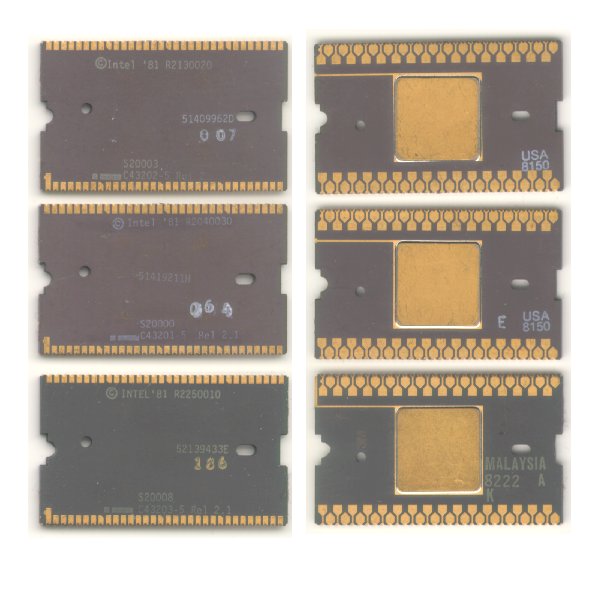
The QUIP was used by Intel and Zilog for bond-out chips for in-circuit emulators. Examples include:
The QUIP package was also used for the Intel iAPX 432 components:
The QUIP was obsoleted by the 68-contact JEDEC Type A ceramic leadless chip carrier, which was used by many vendors. The CLCC has since been replaced by PGA, PLCC, QFP, and BGA packages.
The Intelligent Machines Journal issue of March 14, 1979 includes an article concerting the QUIP, which appears to have been based on an Intel press release.
The Intelligent Machines Journal issue of November 21, 1979 includes a new product announcement for the Intel EM2, an emulation board for the 8022 single-chip microcomputer. The EM2 uses an 8022E bond-out chip, which was packaged in the QUIP package.
Note that there is another, unrelated type of QUIP package that was commonly used by NEC and Rockwell for microcontrollers (uPD78 and PPS-4 series) and by Motorola for the MC10800 series ECL bit-slice components. This package had 42 or 64 leads on 0.05 inch centers, which were formed such that alternate leads extended an additional 0.1 inches from the package body.
Copyright 2000, 2009, 2014, 2015 Eric Smith